
Guide to air sealing your attic
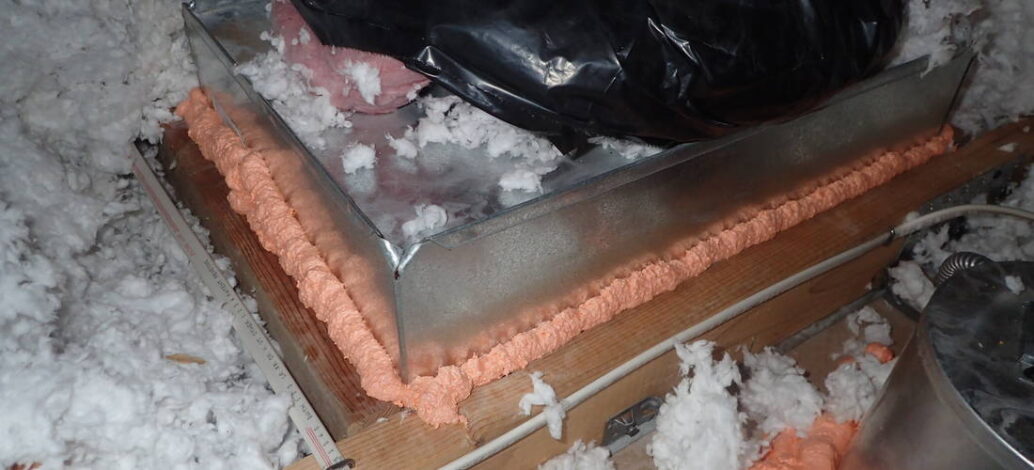
Why air seal your attic?
There are two reasons we care about air sealing. In our industry, we’re approaching it primarily as a technique for reducing moisture and mold growth in the attic. It’s by far the highest ROI solution. The material and labor costs are relatively small, but the impact on moisture in the attic is large. In nearly all cases, moisture accumulation and subsequent condensation on roof sheathing originates from interior moisture generated within the occupied space below. Routine activities such as bathing, cooking, laundry, and respiration elevate indoor water vapor levels. Under heating conditions, buoyancy-driven airflow (stack effect) creates a sustained upward pressure gradient, forcing warm, moisture-laden air toward the attic. This mechanism explains why attics above garages or infrequently occupied spaces rarely exhibit mold growth—interior moisture loads and upward air movement are significantly reduced.
The second reason, and the reason it’s now a code requirement, has to do with energy efficiency. Air sealing the ceiling greatly reduces the heat loss in a home. The impact is quite powerful and often much greater (and cheaper) than adding insulation to the ceiling. The requirement was only recently added to the code. The majority of existing homes are not air sealed.
Does my attic have a problem?
The most obvious evidence is typically condensation occurring on the underside of the roof sheathing. During cold weather, this can be very dramatic. Notice in the water droplets in the image below. While often misdiagnosed as a roof leak, this is entirely due to condensation. Roofers and home inspectors will typically focus on ventilation as the key upgrade. In practice, air sealing is more effective.

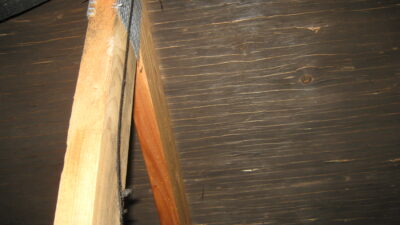
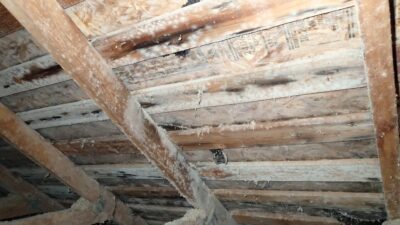
Note – this phenomenon only occurs during the winter months. Even a home with major condensation issues will be perfectly dry during the summer months. During warm weather, you’ll want to look for long term evidence such as mold growth. This mold growth can appear in a variety of colors and growth profiles (white, black, fuzzy, flat, etc.) If the roof sheathing is anything other than raw, natural wood, you may have an issues. Below are examples of typical mold growth.
Black staining on underside of the insulation
This phenomenon occurs when exfiltrating indoor air transports fine particulates (dust, soot) through discontinuities in the air barrier at the ceiling plane. As this air passes through insulation, the fibers act as a filter, depositing particulates and creating visible “ghosting” patterns. Although the staining itself is benign, it is a diagnostic indicator of substantial air leakage at the ceiling-to-attic interface. The dark linear staining observed on the surface of attic insulation typically aligns with the top plates of partition walls.
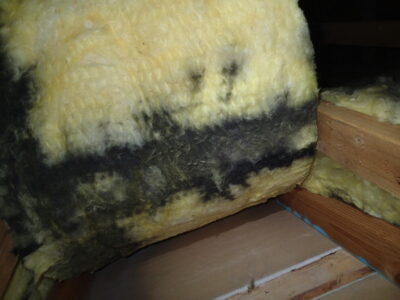
Staining on insulation from air leakage
Air Leakage at Skylights
Skylights represent a frequent source of moisture-related attic issues. Although some failures are caused by exterior water intrusion due to flashing defects, many are driven by air leakage at the skylight shaft. Skylights are often located in isolated or poorly accessible attic zones, where air barrier continuity is difficult to achieve. When combined with elevated moisture loads—particularly when skylights are installed over bathrooms—the potential for condensation increases significantly.
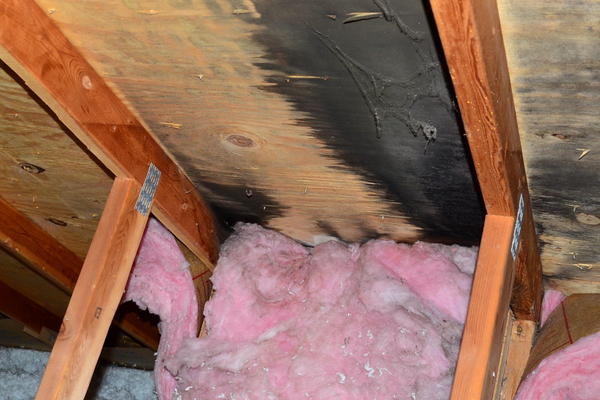
Mold growth due to air leakage / lack of air sealing at skylight
The science of air sealing. Vapor Diffusion vs. Convective Airflow
Moisture transport into attics occurs via two distinct mechanisms: vapor diffusion through building materials and convective transport via air leakage. While vapor diffusion does occur through gypsum board, its contribution is relatively minor. For this reason, building codes require a vapor retarder at the ceiling plane to limit diffusion. Historically, this was provided by asphalt-impregnated (kraft-faced) insulation; more recently, low-perm latex paints or primers are commonly used. However, even with an effective vapor retarder in place, diffusion represents only a small fraction of total moisture transfer.
The dominant moisture transport mechanism is air leakage through penetrations in the ceiling air barrier. These include recessed luminaires, bath fans, attic access hatches, duct and chimney chases, and penetrations through top plates for electrical and plumbing services. As pressurized indoor air escapes through these pathways, it carries water vapor directly into the attic space. Effective attic air sealing targets these discontinuities, substantially reducing moisture migration and associated condensation risk.
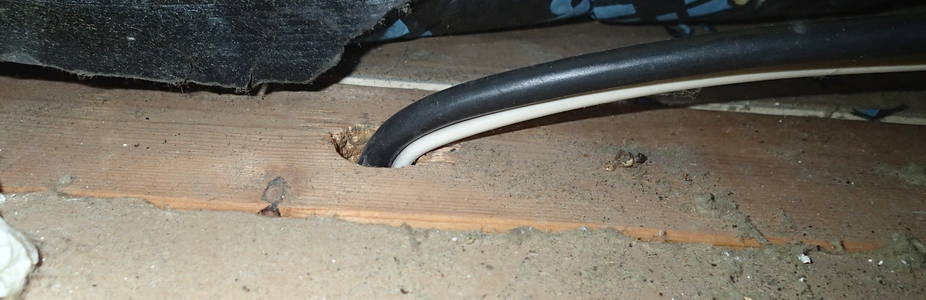
Electrical penetration requiring air sealing
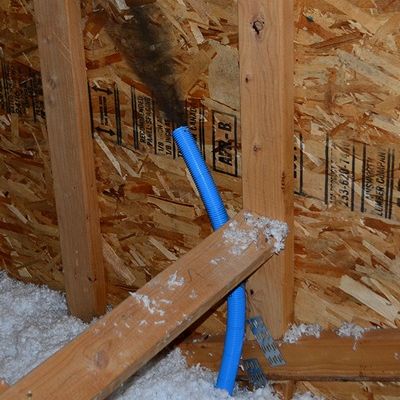
Consequently, the majority of attic condensation and mold issues are attributable to convective moisture transport rather than vapor diffusion through ceiling materials. The image below illustrates an extreme example of this process: an unsealed plumbing penetration permitted continuous exfiltration of warm, moist air into the attic. Upon contact with the cold gable wall, the air cooled below its dew point, resulting in surface condensation and subsequent mold growth. While most failures are less visually pronounced, the underlying physics are identical.
Below is a dramatic example of air leakage in an attic. The blue tubing is unused conduit left exposed in the attic space. This left an unobstructed airway from the warm/humid air inside the home into the attic assembly.
In highly air-sealed wall assemblies, insufficient ceiling-plane air sealing can exacerbate attic moisture problems. When lateral air leakage and incidental drying are reduced, interior moisture becomes more strongly driven upward by stack effect. Even minor discontinuities in the ceiling air barrier can become primary moisture pathways. For this reason, best practice dictates that the ceiling/attic air barrier be more continuous and airtight than wall and window assemblies. In existing housing stock, where ceiling air leakage is common, attic ventilation is often relied upon as a compensatory measure rather than a primary control strategy.
Air Leakage at Demising Walls in Multi-Family Construction
The image below documents condensation and mold growth resulting from unsealed air gaps at the perimeter of an attic shared between adjoining condominium units. Discontinuities at demising walls allowed large volumes of moist indoor air to migrate into the attic space. In multi-family construction, continuous air sealing at partition walls, fire separations, and attic boundaries is critical to controlling convective moisture transport and preventing inter-unit moisture loading.
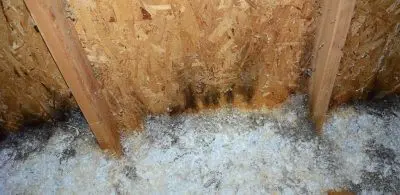
Mold growth on attic partition walls in condo complex.
Air sealing techniques and solutions
1. Framing
- Top Plates (best done during initial construction)
- Electrical and plumbing penetrations through plates
- Sealing methods: Spray foam
2. Ceiling Penetrations
- Recessed can lights (be careful regarding fire issues)
- Ceiling-mounted light boxes
- Bathroom exhaust fan housings
- Smoke detectors and alarm bases
- Sprinkler head penetrations (where permitted)
- Sealing methods: Spray foam, fire-rated foam or caulk, airtight boxes, fire-rated covers (code-compliant where required)
3. Mechanical and Plumbing Chases
- Open chases for ducts, flues, or piping
- Dropped soffits over kitchens and baths
- Open wall cavities terminating in the attic
- Sealing methods: rigid blocking (plywood, drywall, sheet metal) sealed at all edges; fire-rated materials near flues
4. Attic Access Openings
- Pull-down stairs
- Knee-wall access doors
- Sealing methods: gasketed covers, airtight attic stair enclosures, weatherstripping, sealed framing interfaces
5. Wiring and Small Service Penetrations
- Electrical wires penetrating top plates
- Low-voltage wiring (security, data, speakers)
- Cable and conduit penetrations
- Sealing methods: low-expansion spray foam or sealant compatible with wiring
7. Flues and Chimneys (Critical Fire-Safety Zone)
- Metal chimneys and B-vents
- Masonry flues
- Improper clearances to combustibles
- Sealing methods: metal fire-stop flashing with sealed edges; fire-rated sealants only (maintain required clearances)
- Do not foam directly against flues unless explicitly permitted by code
8. Skylight Shafts
- Gaps at ceiling penetration
- Unsealed shaft framing
- Poor air-barrier continuity at shaft walls
- Sealing methods: seal shaft framing to ceiling plane; rigid air barrier with sealed joints
*Heads up – I earn a small commission on sales through Amazon links. This helps cover the expense of running the website (and answering your questions!)