
Efflorescence or Mold Growth?
Efflorescence is often confused with mold growth. Both of them occur in damp environments and exhibit similar growth characteristics, so the confusion is understandable. A common place for both to occur is in the basement, learn how to manage and prevent basement mold growth and efflorscence.
What is efflorescence?

Efflorescence in Basement
- Efflorescence occurs when water migrates through cement structures, carrying salts to the surface. These salts are then deposited on the surface when the moisture evaporates, leaving behind a crystalline-like structure.
Differentiating between mold growth and efflorescence
Due to their similar appearance, the two substances often cause confusion. The easiest way to differentiate between the two is via a water test. Spray a small quantity of water on the suspected substance. Efflorescence will quickly dissolve, while mold growth will remain. The mold growth will likely mat down a bit, so look carefully for lingering material.
Note – while this test is effective with raw, crystalline growth, it will not be useful if the efflorescence is pushing through a painted concrete wall (as is seen in the photo below).

Where is efflorescence typically found?
- The phenomenon typically occurs in concrete or brick construction materials, often during the initial dry out. Large amounts of water are present in the materials during their initial installation. Just pouring a foundation and slab for a 2,000 sqft home introduces thousands of gallons of water. Therefore, we most often find efflorescence in either new construction or existing buildings with water failures.
- Basements are common locations for efflorescence in existing homes and buildings. This is a sign that water is migrating through the concrete structure.
Where does the moisture come from that causes efflorescence?

Efflorescence on Concrete
Pinpointing the exact source of the moisture can be difficult, as numerous entry points are possible:
- Groundwater saturation. Capillary action can easily draw water from wet soil into masonry.
- Rainwater. Either through a leak or through vapor drive. This occurs when the sun hits a saturated wall and drives the moisture inward.
- Sprinklers / artificial water sources. Occurs when sprinklers saturate an exterior wall, causing water to enter the wall and later retreat, carrying salts to the surface.
- Water vapor. Airborne moisture forced through masonry walls can provide sufficient water to cause efflorescence. For example, during the winter months, warm, humid indoor air will move towards the cool exterior.
Does efflorescence require an inspection?
- Efflorescence itself is not a health problem. However, it is an indication of the building’s failure to properly manage water. Therefore, if efflorescence is present, there is a significant chance of mold growth or other moisture issues may be present. For example, while efflorescence on a garage floor will not cause a problem, the accompanying moisture can cause mold growth on items stored on the floor. If the problem is significant, contact a mold inspector or concrete waterproofing company.
Project Report > Inspection for Efflorescence in a Basement
Basement

Efflorescence, not mold.
- RH: 69% Temp: 69 deg F. CO2 = 650 ppm CO = 0 ppm
- The basement was extremely humid due to a wet concrete skim coat being applied to the floor.
- Visible mold growth was found behind the base trim at the landing of the basement stairs.
- The client had applied tape over the visible mold growth to contain the area.
- Once the tape was removed the inspector was able to confirm moderate amounts of mold growth along the bottom 2 inches of sheetrock.
- Sections of sheetrock were broken due to water damage.
- Elevated moisture levels were noted in sheetrock to a height of approximately 10 above the floor.
- Concrete block foundation was slightly damp with some minor efflorescence found on the mortar joints.
- Stair stringers and supporting framing members did not register and elevated moisture levels or visible mold growth.
- The backside of the sheetrock wall found under stairs did not exhibit any signs of water damage or mold growth.
- Ventilation in the basement is minimal and could be increased to allow for the removal of relative humidity and CO² from the rooms.
Recommendations
- The client may wish to treat the concrete wall with a water-sealer membrane to help minimize water vapor diffusion.
*Heads up – I earn a small commission on sales through Amazon links. This helps cover the expense of running the website (and answering your questions!)
Got a question? Ask it here and we'll post the answer below
I have a 2-3 foot long, 8in. wide covering of white cotton like substance on my block wall in basement. It also looks like ther might be some sort of bugs in it, maybe spiders as I saw 5or6 spiders very near the area. Can you help???
There are three possibilities. Mold, efflorescence or spider web. The easiest way to determine if it’s efflorescence is to spray water on the substance. If it’s mold (or a spider web), it won’t change much. If it’s efflorescence, it will dissolve. Finding spiders amid mold growth is rare. I would assume you’re looking at a insect related web/nest. Feel free to upload a photo for further investigation.
This substance grows after the walls become wet after rain falls. It appears to be setting some internal walls also, we are keen to get it sorted. I have lots of pictures but an only upload one. Wondering what can be causing it.

It looks like you have a combination of both efflorescence and mold growth. The black substance near the bottom of the wall is likely mold growth. The whitish substance in the middle of the wall is more difficult to determine. If this is a furred out wall (i.e. wood framing and sheetrock), then it’s not efflorescence. Spray a small amount of water on the substance. If it completely dissolves, it’s efflorescence. If it mats down a bit, it’s likely mold.
Both are the result of moisture intrusion. I would contact a drainage specialist and have them inspect your downspouts, drains, etc. I would also consider removing a small piece of sheetrock. If there’s no mold on the backside, you’re likely dealing with a humidity issue. If mold is present, you’re looking at a liquid water intrusion.
I suspect this to be efflorescence. This is from a concrete wall that is partially underground. This started to show up after a recent rainfall.

You are correct – this is efflorescence. The efflorescence itself isn’t a problem. It’s just crystal deposits left on the surface due to moisture migrating within the concrete. If you plan on leaving the concrete wall exposed, no further action is necessary. If you intend on finishing out the wall with framing, dry wall, etc. you’ll want to take steps to stop the moisture movement or install dimple board to direct the water downward.
We are making a bedroom in the basement for my teenage daughter and want to paint the concrete walls. We bought the house 4 years ago and the basement was treated for mold and had remediation done. I’m thinking it is back. It’s a white substance and wiped it down but it came back! Not sure what to do!

This is almost assuredly efflorescence, not mold growth. If it disappears when sprayed with water, it’s efflorescence. As noted in the article above, this indicates water is moving through the concrete wall. Do not cover this wall with insulation, framing or sheetrock without addressing this moisture issue. If you intend on finishing the basement, you’ll want to first install dimple board on the walls to direct water toward the floor. At the floor, install a internal footing drain and a sump pump.
Alternatively, you can simply leave the concrete wall uncovered and allow the moisture to harmlessly enter the room as vapor. It only becomes a problem when you cover the wall.
Is this white mould or efflorescence?

This is a tricky one. You can rule out efflorescence, due to the fact it’s occurring on metal. Efflorescence only appears on masonry surfaces.
Mold also seems unlikely. Direct growth on metal ducts is extremely rare. This would require large amounts of continual moisture combined with a heavy layer of existing dust. Also, the line between the white substance and the clear sheet metal is too precise for mold growth. You would expect a more diffuse edge.
Does this duct opening have a filter box? If so, occasionally you’ll see dust accumulation at the edge of a poorly fitting filter. Typically it is grey or black, not white.
My guess? This is overspray from the sheetrock texture.
If you’re looking for a firm answer, you can take a small sample in a bag and drop it off at your local environmental testing lab. At a minimum they can rule out mold.
This is a basement wall, below a window.From some of the other posts it looks like efforvesence, but no white fluffy powder. Now I'm worried about structural integrity. What do you think? Thanks
Yes, this is very likely efflorescence. Often it forms with an orange, bubbled surface. This typically does not impact the structural integrity directly, although it is a sign of failed/poor drainage and water management. I recommend contacting a basement drainage/waterproofing contractor to assess the issue. Often simply redirecting the downspouts on the exterior can alleviate the issue.

asdf
I have this substance on the wood in my basement. It's white chunky and dry. I tried spraying a thin portion with water and it immediately disintegrated.
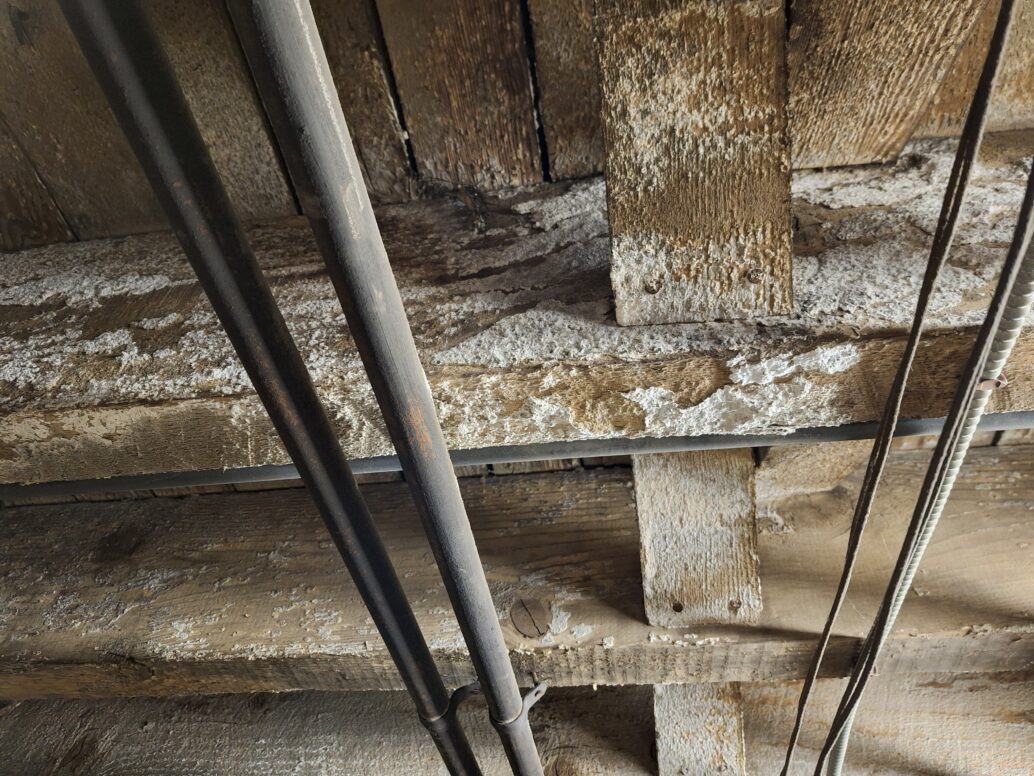
This is one of the strangest submissions I’ve seen. The appearance looks very similar to efflorescence, but that phenomenon typically requires the proximity of masonry or concrete. The pattern does not correlate with typical mold growth either. There are some types of yeasts that produce much more tangible substances than mold growth. However, those would not likely produce independent areas of growth.
A possible solution is repeated exposure to water with high mineral content. As the water evaporates, the minerals are left behind, leaving the white, flaky residue. To fully verify this theory, we’d need to know the history of the building, recent water intrusion, etc.
Hi! Okay, after going through your learning center, I feel confident that this white layer is efflorescence. when I first seen it, it looked hard to the touch, now its completely flattened. this wall is between the garage and laundry room. water has been migrating through this wall for over a year. no constantly but as consistently as one runs a washer machine. the water is coming from the washing machine, its a Crack in the sink that the output drains Into. high humidity and years of dust, because the basement was ignored, has led to mold growth in different spots. I know its in this wall and have accepted this is going to cost. at this point I think the whole thing should be left behind, im willing to fight but would do you suggest?
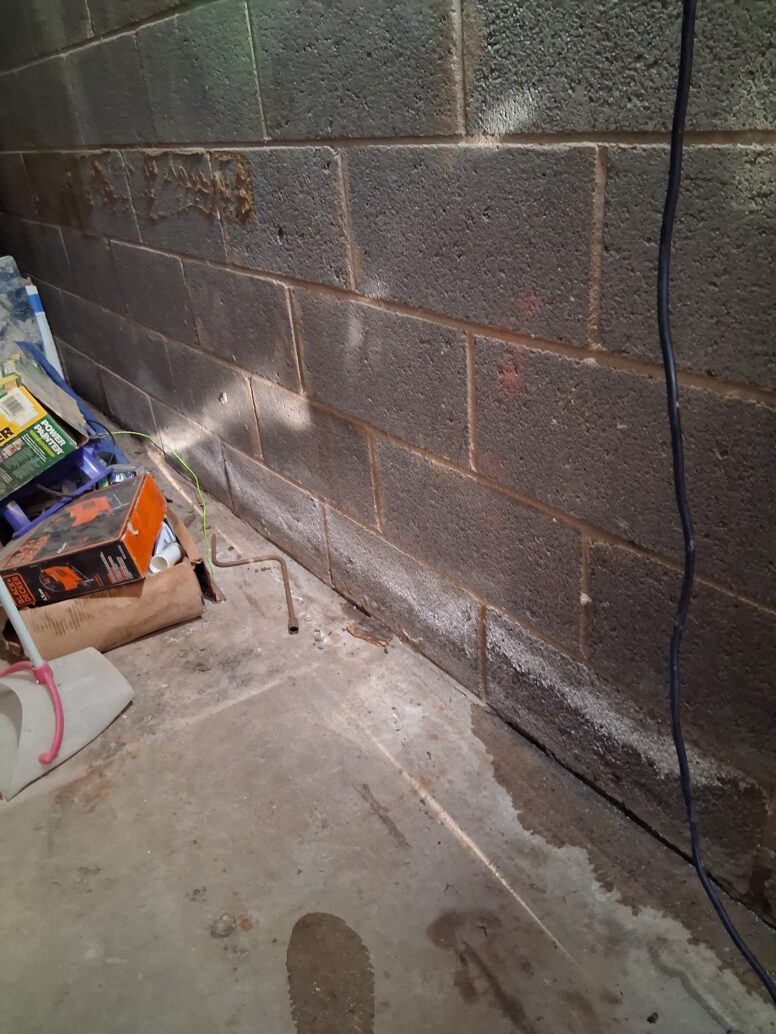
I agree, this definitely looks like efflorescence. Masonry walls do not typically require destructive remediation. Instead, focus on addressing the ongoing water intrusion. Once this is completed, clean the surface of the brick wall. Any lingering mold within the wall cavity will become deactivated.
I have this all over my basement walls. I sprayed if with water and it disappeared so according to you this is definitely efflorescence. My question is how to treat it before applying a concrete stain with sealer to my walls. Is a wire brush or a power wash enough or should I use chemicals designed for removing efflorescence? Thanks in advance.
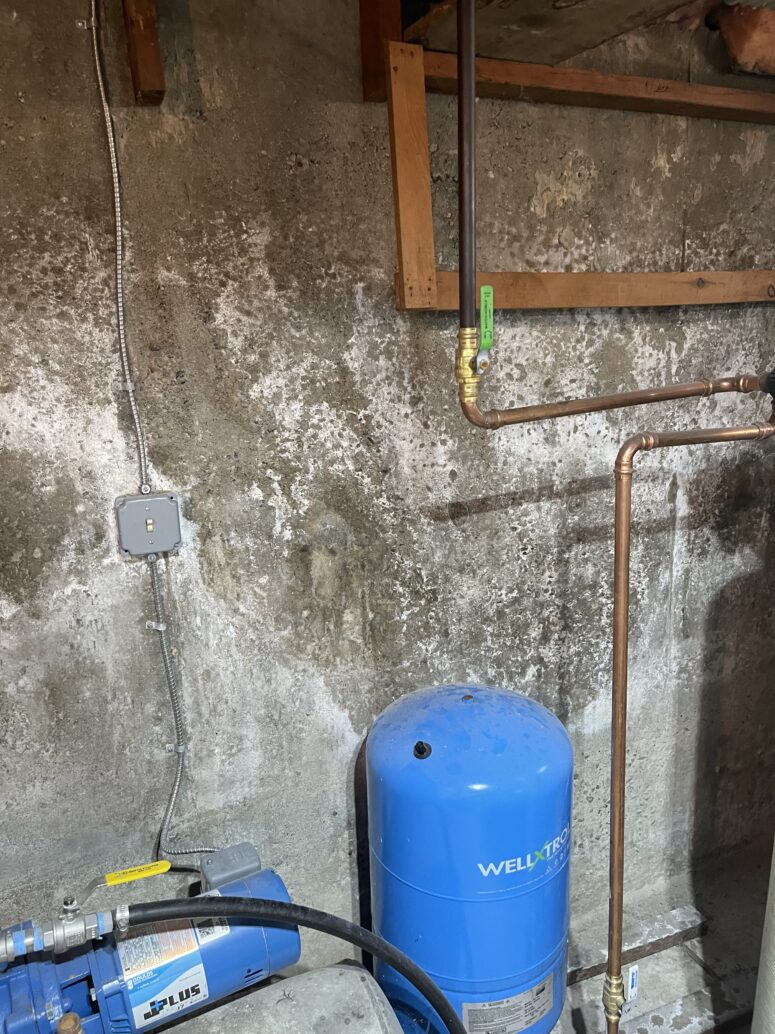
Yes, a wire brush or power wash is sufficient. Your goal is to simply clean the surface, not attempt to penetrate the concrete. Sealers can work with minor water issues, but in time, the coating will eventually fail. Either efflorescence will occur on the surface or the coating itself will bubble and lose adhesion.
The best option, if possible, is to reduce the water pressure from the other side of the wall. I.e. improve drainage, redirect downspouts, etc. If this isn’t possible, installing dimple board with a corresponding interior footing drain and sump pump can be very effective. This is a big investment and only really necessary if you plan on finishing the basement wall.
The last and likely most feasible option is to simply allow the efflorescence to occur and implement a periodic cleaning schedule. The deposits themselves are not a health concern. As long as the wall can adequately dry out, this is the approach I would recommend.